How an Amish Boy Became a Physicist, Part 3
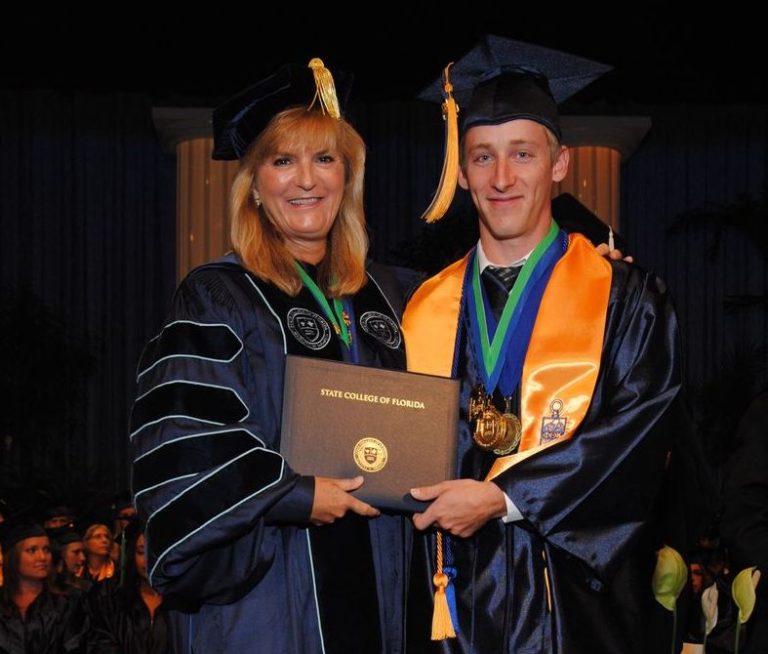
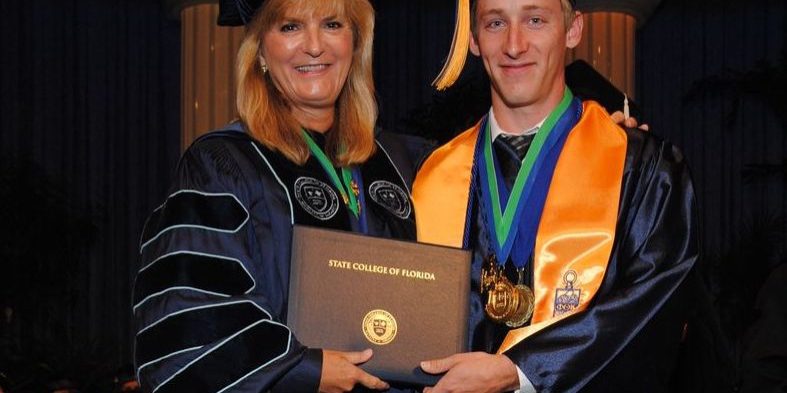
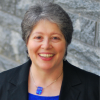
Leon graduating from Florida State University
Today we bring you the conclusion of Leon Hostetler’s story. I first knew of him when he was writing a blog more than ten years ago before he started college and he was clearly upset, even bitter, that his schooling had been interrupted after the eighth grade. I remember that feeling for years after I left my community. I could tell from Leon’s writing that he had a level of intelligence that would be a crime to waste, so I wrote to him and encouraged him to pursue college. I also reached out to Emma Miller to let her know about Leon.
Leon recently wrote this to me: “I had always thought college would have to wait until I had money. You and Emma Miller (of ADSF fame) encouraged me to stop waiting and to apply for the ADSF scholarship. If not for the two of you, I wouldn’t be where I am today—at least not yet. I might still be waiting until I thought I could afford it.”
It is a great pleasure to publish the rest of Leon’s story. Here it is.
College and Graduate School
By Leon Hostetler
I started at the nearby community college. I still dreamed of being a physicist, but they had no degree program for that. So I started with a 2-year general studies degree—an Associate of Arts. To reduce rent costs, Esther and I moved in with her parents. My scholarship and grants covered the cost of tuition. To cover living costs, I mowed lawns.
I took writing, ethics, and other general education classes interspersed with science classes like chemistry and physics, and a lot of math classes. I found something to love about every class, but the math classes were my favorite. On the one hand, there is the difficult mechanics of doing math, which most people don’t enjoy. I didn’t find it particularly fun myself. What got me excited were the occasional glimpses that I got of a bigger picture. A deep structure that is perfect and ordered, and feels more real than the real world. I didn’t understand how some people could look at a work of art and feel deeply moved until now. A mathematical theorem feels to me like a discovered work of art—something that can’t be created because it is the very fabric of reality. It can only be discovered and appreciated.
After my two-year degree, I was accepted to Florida State University to complete a bachelor’s degree in physics, so Esther and I moved to Tallahassee. I was able to make a little money tutoring at the nearby community college, but I had to take out student loans to cover tuition and rent. But with an in-demand degree like physics, I felt confident that it was a good investment. The coursework was difficult but manageable and exciting, and for the first time, my dream of being a physicist started looking like a real possibility. I would need a Ph.D. for that, and I began preparing for it several years in advance.
Knowing that graduate schools like to see some research experience, I asked around about options, and was soon matched with a professor working in lattice field theory—an area of particle physics which uses supercomputers to solve problems that can’t be solved any other way. This would be my first exposure to real scientific research.
A lot of the work (programming, writing, studying other scientists’ papers) was more tedious than I had anticipated. Flashes of insight and huge breakthroughs didn’t happen every fifteen minutes. It was much, much slower than that. Even so, there were moments that I lived for. One such moment was when I ran a new program that I’d written to analyze the latest data coming from the supercomputers. As I paused with my finger hovering over the Enter button that would start the analysis, I felt a tingling anticipation. The result would be some number, but I didn’t know exactly what it would be. It was a mystery. Furthermore, because this specific analysis had never been done before, nobody alive or dead knew what I would find. Then I pressed the button. When the numbers came in, I was briefly the only person in the world to know that particular thing about our universe. However inconsequential my own work may be in the larger field of physics, it is still the best feeling in the world to be the first to know something.
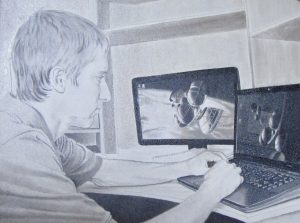
An unfinished portrait of Leon at his desk by his late friend Daniel Fisher
After my bachelor’s degree, I enrolled in the physics Ph.D. program at Michigan State University. Financially, graduate school was very different from undergrad. I was fully funded with free tuition plus a stipend that covered rent, food, and other cost of living expenses. In that sense, it was more like a job than school. For the first time in my life, I was being paid to learn and do research. It felt both fulfilling and somehow undeserved. I started my own research project in lattice field theory, supported by a host of advisors. Twenty years earlier I don’t think anybody would’ve guessed that this Amish kid who lived without electricity or electronics of any kind would grow up to use the largest supercomputers in the world to do his very small part in revealing the big picture. It was truly a dream come true. I never got bored—there was always more to learn—and I finally felt like I was doing what I was born to do.
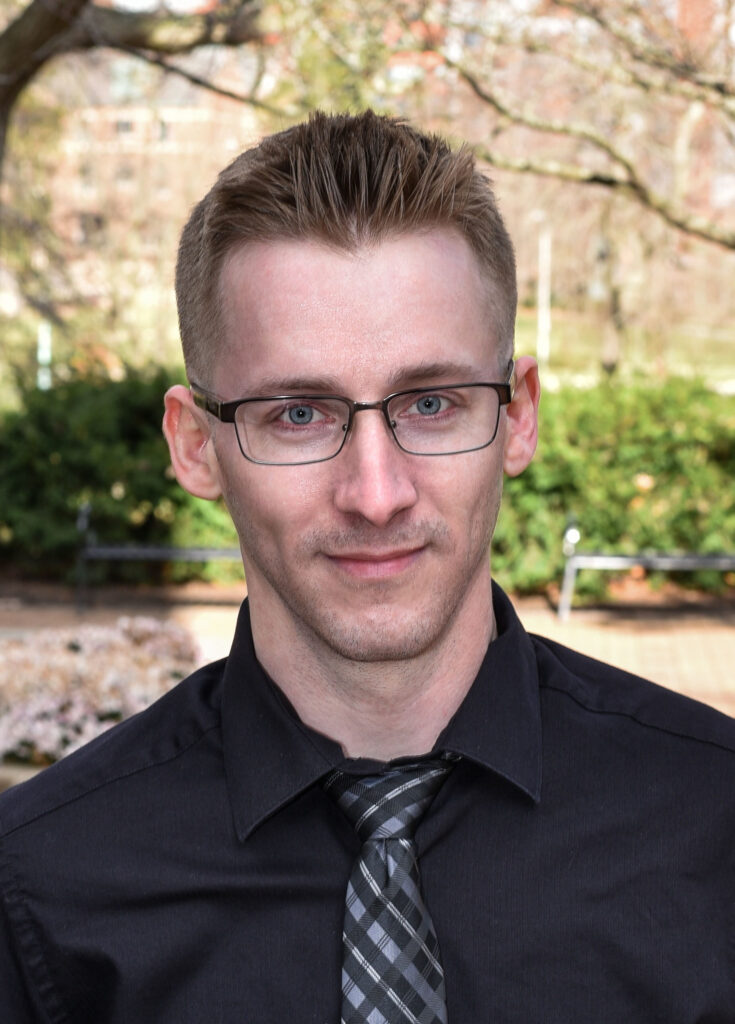 Esther and I live in Bloomington, Indiana where I am working as a postdoctoral scholar in the Department of Physics at Indiana University. It’s been over two years since I graduated with my Ph.D. My current work is a continuation of the kind of research that I did during my Ph.D. but now on a larger scale. Mine is a temporary contract—four years at most, and I’m more than halfway through it already. I don’t know what comes next, but I’m sure it will be an adventure. I still don’t fully see the big picture, and I probably never will, but I feel like I am where I belong.
Author’s note: For many years, I believed that higher education was financially out of reach for me. I was wrong, and I regret waiting as long as I did. I hope my story will encourage someone to take a step they want to take—even if it feels like blindly stepping off of a ledge.
This concludes Leon Hostetler’s story. You can read Part 1 here and Part 2 here.
If you are inspired by Leon’s remarkable story, especially by how the Amish Descendant Scholarship Fund was fundamental in how he got started on his college journey, will you consider donating to ADSF? We now have non-profit status and can offer the option of donating online by following this link. You will make a difference in the lives of an intelligent, dedicated, and hard-working group of student applicants this year, for which they will be ever so grateful. Thank you for reading, and thank you for your generosity.
Plain Roots: Community, Story, and Support for Higher Education
We are getting glimpses of Spring up here in northern Vermont. David and I spent…
Traveling South to Meet up with Spring
By the time you read this blog post, David and I will be on the…
How an Amish Boy Became a Physicist, Part 3
Leon graduating from Florida State University Today we bring you the conclusion of Leon Hostetler’s…
To order a signed copy of my book(s), click on an image below. You will be taken to the books page of my author website to purchase.

Leon’s story made me smile. I am so happy for him. Great job!